
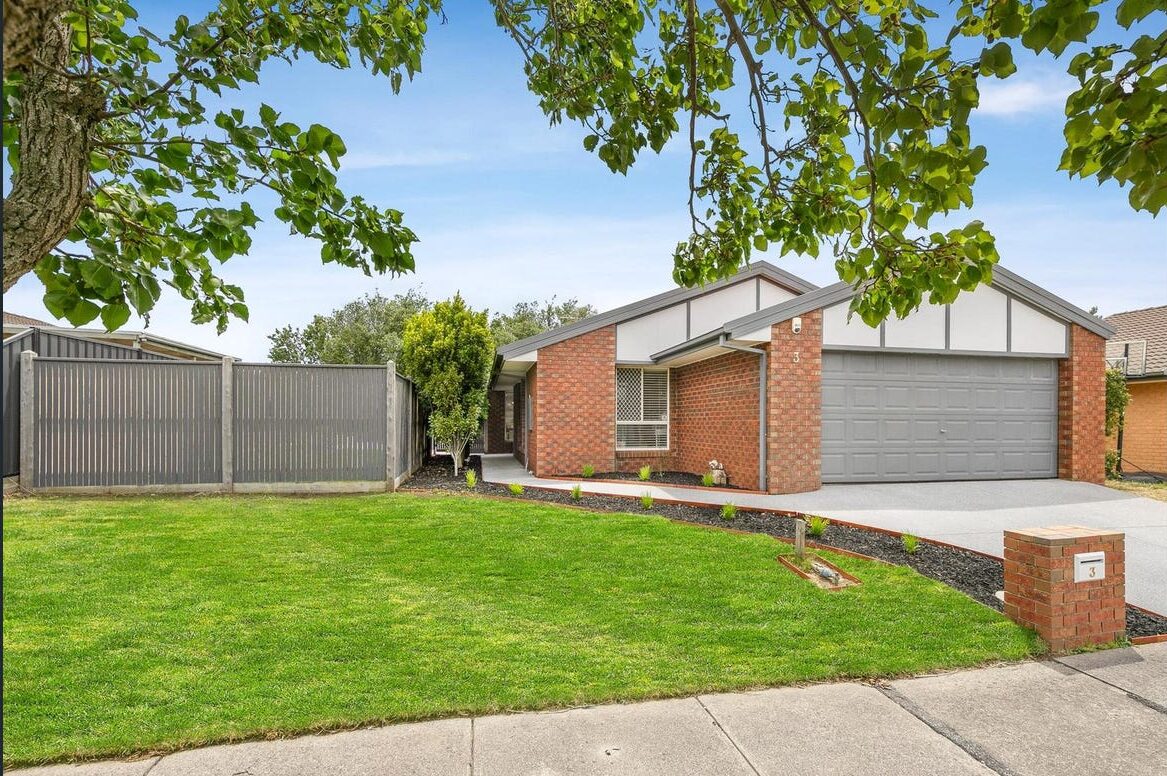
Hillside, 3037 at a glance ‐ key facts (mid-2026)
| Metric | House | Unit |
|---|---|---|
| Typical value (HTAG) | $1,047,000 | $596,000 |
| 12-month capital growth | +7.28% | +3.92% |
| Quarterly growth | +1.61% | +0.80% |
| 5-year annualised growth | +5.18% | +4.01% |
| 10-year annualised growth | +6.03% | +5.09% |
| Median weekly rent | $529 | $460 |
| Gross rental yield | 2.63% | 4.01% |
| Sales in past 12 months | 185 | 32 |
| Average days on market | 27 days | 26 days |
| Stock on market | ~0.2% of dwellings | ~0.38% of dwellings |
| Months of inventory | ~1.6 months | ~2.0 months |
| Average hold period | ~10.8 years | ~8.5 years |
| Owner-occupier rate | ~85% (only ~15% rented) | |
| Distance to Melbourne CBD | ~24km north-west | |
Sources: HTAG Intelligence (suburb-level market data, to May 2026) and ABS Census 2021, alongside the author’s direct experience. Note the suburb-wide “typical value” of ~$1.05m for houses is pulled upward by prestige acreage pockets ‐ see below for what an everyday family home actually costs.
If you’ve spent any time house-hunting in Melbourne’s north-west, you’ll know the names that get shouted about. Taylors Lakes. Caroline Springs. Sydenham, with Watergardens humming away at its centre.
And then, sitting quietly just to the north of all of it, there’s Hillside.
I’ve driven every pocket of this suburb, north and south of the Melton Highway, the acreage streets, the tight little courts, and Hillside is one of those places that genuinely surprises buyers the first time they actually stop in it, rather than passing through on the way to somewhere else.
It doesn’t have a café strip pulling crowds in on a Saturday. It doesn’t shout. What it has instead is something a lot harder to manufacture ‐ a settled, family-first community where people buy in and simply stay.
Let me show you why.
Where is Hillside, and why do families love it?
Hillside sits about 24km north-west of the Melbourne CBD, roughly a 35-minute drive door to door, traffic depending.
For the train commuters, Watergardens Station in neighbouring Sydenham is only an 8-10 minute drive away, and from there it’s about 45 minutes into the city on the Sunbury line. Watergardens is also where most Hillside locals do their proper shopping ‐ it’s the biggest retail centre in the area.
But the thing that defines Hillside isn’t the commute. It’s the feel.
And while Hillside isn’t a café-strip suburb, it does have one genuine drawcard ‐ Baked Since 95, a local brunch spot that people happily drive in from neighbouring suburbs for. When a quiet, residential suburb has a café pulling outsiders in on a Saturday morning, that tells you something about the place. People don’t make the trip for somewhere forgettable.
This is a small suburb, fewer than 6,000 dwellings, and a population of around 17,000. The average household here has 3.2 people in it, which tells you exactly who’s buying ‐ larger families, settling in for the long haul, not investors flipping one-bedders.
Hillside is one of the outer-north-west suburbs where the owner-occupier culture is strong enough that you can almost feel it on the streets at school pick-up time.
And the data backs that feeling up.
- Only around 15% of homes in Hillside are rented, the rest are owner-occupied (the 2021 Census put owner-occupation at 83%, and HTAG’s latest read sits around 85%).
- The suburb scores a 7 out of 10 on the ABS IRSAD index, a measure of socio-economic advantage. That’s high, and it means buyers here aren’t navigating the social-housing pockets or stigma streets you have to work around in some other “investment-grade” suburbs.
- The average Hillside homeowner holds their property for nearly 12 years, and that number is trending up.
When people don’t want to leave, stock stays scarce. We’ll come back to what that means for buyers.
The Hillside market right now: where conditions actually sit (mid-2026)
Before we get into pockets and prices, here’s the one-paragraph read on the market as it stands in mid-2026, because it’s the question every buyer asks me first.
Hillside is a steady, gently rising market, not a speculative one, and not a cooling one. On HTAG’s latest figures (to May 2026), the typical house value sits at around $1,047,000, up 7.28% over the year, with the most recent quarter also positive (+1.61%). Units have moved more modestly, up 3.92% over the year to a typical value around $596,000. So the headline read is simple ‐ solid, broad-based growth, low volatility, no sign of a correction. This isn’t a suburb sprinting on hype or stalling. It’s a suburb that just keeps grinding upward.
The other defining feature of the market is how little of it actually trades. Stock on market sits at roughly 0.2% of all dwellings at any given time, with only about 1.6 months of inventory, both extremely tight for a suburb this size. Building approvals are negligible (around 0.1% of dwellings), so there’s no wave of new supply coming. In plain terms ‐ demand is steady, supply is thin, and that’s exactly the backdrop that keeps a settled family suburb firm rather than volatile.
House vs unit: how the two segments behave
Hillside is overwhelmingly a house market, units make up only around 10% of dwellings, but the two segments are worth separating, because they don’t move in lockstep.
| Metric (rolling 12-month) | Houses | Units |
|---|---|---|
| Typical value | $1,047,000 | $596,000 |
| 12-month capital growth | +7.28% | +3.92% |
| Gross rental yield | 2.63% | 4.01% |
| Sales (12 months) | 185 | 32 |
| Days on market | 27 days | 26 days |
Two things stand out. First, houses did the heavier lifting on growth over the past year (7.28% vs 3.92% for units) ‐ no surprise in a suburb where the family home on a proper block is the thing everyone actually wants. Units have grown more gently, but they remain the affordable entry point that brings first-home buyers into the suburb. Second, the volumes tell the real story ‐ 185 house sales against just 32 unit sales. Hillside is, and will remain, a house suburb. Units are a small, lower-priced slice at the more affordable end, not the main game.
Market speed: how quickly things move
A good market read isn’t just “what are prices doing,” it’s “how fast is the market moving.” Here, the answer is: briskly, for so little stock. Homes that come to market are selling in roughly 27 days for houses and 26 for units, and the suburb turns over only about 18 sales a month (close to 200 a year across houses and units combined). Auction clearance sits in the low-60s percent and the rental vacancy rate is a tight ~1.4%. None of that points to a market under pressure in either direction. It points to a tightly held suburb where good stock is scarce, moves quickly when it appears, and clears at sensible prices, which is precisely why timing and access matter so much here.
North vs south of the Melton Highway: the line that actually matters
The Melton Highway cuts Hillside roughly in two, and the two halves behave like slightly different suburbs.
North of the highway is the heart of owner-occupier Hillside. It’s family street after family street, and it’s become noticeably more desirable since Banchory Grove Shopping Centre opened, with the Woolworths arriving in March 2025. Suddenly locals had their daily essentials a few minutes from the front door instead of a drive across to Watergardens, and that convenience quietly re-rated the whole northern pocket.
We were buying in this pocket a year before that shopping centre opened. That’s the part most people miss ‐ the time to buy into a suburb is before the amenity lands, not after everyone can see why it’s a good idea.
It’s a great pocket for our investor clients, too. You can pick up an extremely well-presented 3-bedroom, 2-bathroom home on a 500-600sqm block for the high-$700,000s to mid-$800,000s, and occasionally a 4-bedroom home in the same range if it needs a bit of work.
One thing I’ll add from years of running inspections out here ‐ these homes are well-built and well-cared-for. Most building-and-pest reports come back genuinely clean, even though much of the stock is now 25-30 years old. That’s not a given in every outer-growth suburb, and it’s a quiet point of confidence for buyers.
South of the highway is a different story ‐ more investor-owned, a lot more units, and a more mixed streetscape. There’s real value to be found there, but it sits among a lot of stock you’d want to step around, so I’ve given it its own section below.
Neither half is “bad.” But if you’re an owner-occupier buying for the long term, and most people in Hillside are, the northern side is where the tightly-held family homes live, and where the competition at open homes is strongest.
Cana Catholic Primary School and the family pull
You can’t talk about why families plant roots in northern Hillside without talking about schools.
Cana Catholic Primary School is genuinely sought-after by local families, and in a suburb this owner-occupied, a school like that does real work on demand. Parents buy into the zone and the community, and then, true to Hillside form, they stay.
It’s a small thing on paper. On the ground, it’s one of the quiet engines keeping northern Hillside so tightly held.
South of the Melton Highway: real value, if you know what to step around
Now, don’t write off the southern side. There’s genuine buying down here ‐ you can pick up a 4-bedroom, 2-bathroom home on a 600sqm block in the low-to-mid $800,000s, which is real value for the size.
The catch is the context. South of the highway is more investor-heavy, with a lot more units, townhouses and small blocks mixed in among the family homes. So the value is there, it’s just sitting amongst a different streetscape.
A few specifics worth knowing:
- There’s a cluster of amenity around the Parkwood Green Community Centre, home to the Parkwood Green pre-school and right beside Parkwood Green Primary School, on Community Hub. Lovely to have nearby. But I generally wouldn’t buy on Community Hub itself ‐ with two schools that close, it gets hectic at drop-off and pick-up, and that daily congestion is a real liveability drag.
- Expect a lot of small 300sqm blocks and townie stock through here, fine for some strategies.
- Jade Way is a street full of townhouses with a genuinely nice streetscape, and affordable homes here in the $600,000s, a reasonable entry point if a lower-maintenance townhouse suits your plan.
What you’ll actually pay in Hillside (and why the median is misleading)
Now, the bit everyone scrolls down for. Let’s be straight about the numbers, because the headline figure can trip you up.
Here’s the first thing to understand ‐ the suburb-wide “typical value” for a Hillside house sits at around $1,047,000 on HTAG’s latest data. But that figure does not describe the everyday family home, and if you take it at face value you’ll talk yourself out of a suburb you can comfortably afford.
So why the gap? Because that higher figure is dragged upwards by two prestige pockets, Hillside 2000 and Sugargum Estate, where homes trade well north of $1.5M and even $2M. Those acreage and large-block sales pull the average away from what a normal family home actually costs.
In reality:
- A standard family home on a 600sqm block is great buying up to the mid-$800,000s.
- You can occasionally still find something on a 500sqm block in the high-$700,000s.
So if you saw a “$1M median” and quietly closed the tab, don’t. The everyday Hillside family home is meaningfully more affordable than the headline suggests, you just have to know which part of the bell curve you’re shopping in.
And here’s the neutral, plain-English read on the trend, because it matters ‐ Hillside isn’t spiking on speculation and it isn’t sliding. HTAG has house values up 7.28% over the year (with the latest quarter also positive), while the longer-run picture is just as healthy ‐ around 5.2% a year over five years and 6.0% a year over ten. Whichever timeframe you lean on, the picture is the same: steady, low-volatility growth in a tightly held suburb, not a sharp boom-and-bust. That’s exactly what you’d expect, and want, in a hold-forever owner-occupier market.
Hillside 2000: the prestige pocket on Castlewellan Boulevard
Hillside was first built out from the late 1990s into the early 2000s.
The estates developed in that era include Hillside 2000, and this is the prestige end of the suburb. Castlewellan Boulevard runs through it, lined with homes typically sitting on 2,000sqm blocks, most valued well over $1.5 million.
How tightly held? The last sale on the boulevard was back in November 2024, when 14 Castlewellan Boulevard, a 4-bedroom, 2-bathroom home, sold at auction for $1.5M. More recently, in December 2025, even a vacant block at 66 Castlewellan changed hands for $1.5M.
Read that again ‐ a bare block of land matched the price of a built family home. That’s what genuine scarcity looks like.
Sugargum Estate: acreage living, minutes from the city
Sit just to the east of Hillside 2000, run toward the green ribbon of Stony Hill Creek, and you’ll find Sugargum Estate, and this is the rarest air in the whole suburb.
We’re talking acreage-style blocks up to 6,000sqm, with custom-built homes and a semi-rural lifestyle feel that’s almost impossible to find this close to the CBD. Supply here is even tighter than Hillside 2000, and Sugargum Drive is 100% owner-occupied.
To give you a sense of the level: 15 Sugargum Drive, a 3-bedroom, 2-bathroom home, sold in May 2026 for $2.3 million.
For a certain kind of buyer, the family that wants space, privacy and a paddock-sized backyard without surrendering the 35-minute commute, there’s almost nothing else like it in Melbourne’s north-west.
Is Hillside a good place to buy in 2026?
Here’s how I read it as a buyer’s advocate.
Hillside isn’t a flashy, momentum-chasing suburb. It’s the opposite ‐ a settled, high-owner-occupier family market where people buy once and hold for a decade or more.
That has real consequences for anyone trying to buy in:
- Stock is desperately scarce. Just 0.2% of Hillside’s housing is listed for sale at any given time, and there’s only about 1.6 months of inventory on the market. When something good comes up, it goes.
- Almost nothing new is being built. Building approvals run at around 0.1%, negligible. There’s no flood of new supply coming to soften prices.
- The owner-occupier base is rock solid. With only about 15% renters and a high IRSAD score, you’re buying into a stable, advantaged community rather than betting on a turnaround.
The trade-off is yield. The suburb-wide blended gross yield sits around 2.6%, but on that well-presented 3-bedder in the high-$700,000s to mid-$800,000s, yields run closer to 3.6%. Still not a high-yield play, and not feasible for every investor depending on where you are in your journey ‐ but a long way from the 2.6% the headline implies.
So Hillside rewards two kinds of buyers: the owner-occupier who wants a forever home, and the investor playing for steady capital growth and quality, low-maintenance stock rather than chasing yield.
Frequently asked questions about Hillside, 3037
Hillside is a residential suburb roughly 24km north-west of the Melbourne CBD, about a 35-minute drive from the city. The nearest train station is Watergardens in Sydenham (an 8-10 minute drive away), with about a 45-minute trip into the city on the Sunbury line.
For owner-occupiers and long-term family buyers, yes. Hillside has a very high owner-occupier rate (only about 15% of homes are rented), an above-average IRSAD score of 7, and an average hold period of nearly 11 years. The main challenge for buyers is scarcity, only around 0.2% of housing is listed for sale at any one time.
HTAG’s suburb-wide typical house value is around $1,047,000, but that figure is inflated by prestige acreage pockets like Hillside 2000 and Sugargum Estate. A standard family home on a 600sqm block typically sells in the mid-$800,000s, and smaller 500sqm homes can occasionally be found in the high-$700,000s.
The typical unit value is around $596,000 (HTAG, to May 2026), up 3.92% over the year, with units selling in about 26 days. Units make up only around 10% of Hillside’s dwellings, so it remains overwhelmingly a house market.
It’s steady and consistently rising rather than booming or cooling. House values are up about 7.28% over the past year on HTAG figures, with the most recent quarter also positive, and longer-run growth averaging around 5-6% a year. Very tight supply (about 0.2% stock on market) keeps the market firm.
Very much so. With an average household size of 3.2 people, strong owner-occupier culture, lots of green spaces, and sought-after schools like Cana Catholic Primary School, Hillside is geared squarely toward larger families settling in for the long term.
North of the Melton Highway is the predominantly owner-occupied, family-focused part of the suburb, and it’s become more desirable since Banchory Grove Shopping Centre (with its Woolworths) opened in 2025. South of the highway is more investor-heavy with a lot more units, townhouses and small blocks ‐ there’s good value, including 4-bedroom homes on 600sqm in the low-to-mid $800,000s, but more mixed stock to navigate.
The suburb-wide blended gross yield is around 2.6%, with units yielding about 4.01%. On a typical investment-grade family home in the high-$700,000s to mid-$800,000s, gross yields run closer to 3.6%. Hillside suits capital-growth investors more than yield-focused ones.
For owner-occupiers and investors after quality family homes, the owner-occupied pocket north of the Melton Highway is the standout. South of the highway offers value but requires more care around unit and small-block stock, and busy school-adjacent streets like Community Hub are best avoided for liveability.
Both are the prestige pockets of Hillside. Hillside 2000, centred on Castlewellan Boulevard, features homes on around 2,000sqm blocks valued well above $1.5 million. Sugargum Estate, beside Stony Hill Creek, offers acreage-style blocks up to 6,000sqm with custom-built homes and is even more tightly held ‐ Sugargum Drive is 100% owner-occupied.
The bottom line on Hillside
Hillside isn’t a “set and forget” suburb in the sense that any pocket will do. The line down the Melton Highway matters, and so does the street.
Buy on the wrong side of it, among the units and small blocks, and you’ll feel it in resale and in the quality of the streetscape around you.
Buy in the right pocket, the owner-occupied family streets north of the highway, in a good school zone, on a proper block, and you’ve got an asset in a suburb that grows steadily, almost never comes up for sale, and is held by families who have no intention of leaving.
That’s not a punt. That’s a plan.
And if you’re weighing up Melbourne’s north-west, I’d gently suggest: in a market this tightly held, the hard part isn’t deciding to buy, it’s getting in when so little in the great pockets ever comes to market.
Interested in buying a family home or investment property in Hillside or Melbourne’s north-west? You can book a call with First Move Property Advisory to discuss your brief.
About the Author: Haley Lim
Haley Lim is the Founder and Managing Director of First Move Property, a passionate property investor, and a trusted Melbourne buyers advocate with a deep understanding of the local market.
Before launching First Move Property, Haley was a professional negotiator who held senior leadership roles and led high-stakes commercial negotiations in the fuel and energy industry worth billions of dollars across Europe, Australia, and New Zealand.
This background gives her clients a distinct advantage, combining strategic thinking, calm execution, and expert negotiation. Today, Haley brings that same discipline and data-driven thinking to every client she represents. More than a buyers advocate, she is a mentor, advisor, and trusted partner, passionate about empowering home buyers and property investors to navigate the Melbourne property market with confidence.
Connect with Haley: LinkedIn | Email: haley@firstmoveproperty.com.au | Phone: 0477 555 783
Market data in this article is sourced from CoreLogic/Cotality (via YourInvestmentProperty) and HTAG Intelligence, mid-2026, alongside the author’s direct experience. This article reflects the author’s professional opinion and does not constitute financial advice.
Disclaimer: The information in this article is general in nature and does not constitute professional financial or investment advice. Property investment involves risks. We recommend seeking independent financial, legal, and taxation advice before making any real estate decisions.